[Bhutan] Exploring the Path to Sustainable Development and National Happiness
2026-02-03
Meeting with Former Bhutanese National Assembly Speaker Pasang Dorji
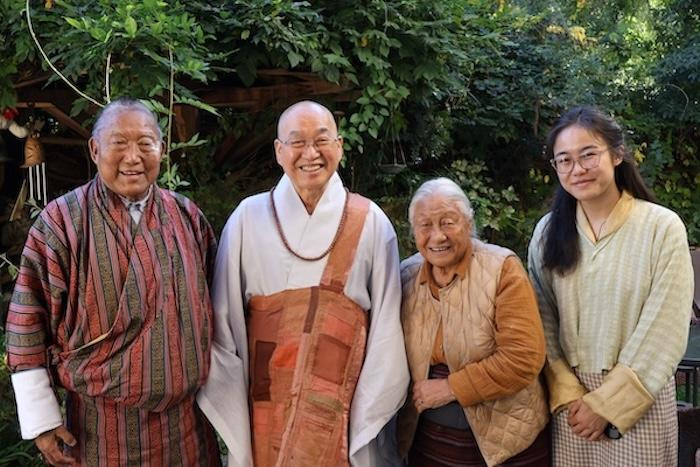
On November 4, 2025, Venerable Pomnyun, Chairman of JTS, visited the home of Mr. Pasang Dorji, the former Speaker of Bhutan’s National Assembly, for a meeting.
Mr. Pasang Dorji first met the Venerable when they happened to encounter each other in India during the Venerable’s pilgrimage to Buddhist holy sites last year, and they have maintained a connection since then.
Because Mr. Pasang Dorji had been in poor health, it had been difficult to meet him in Bhutan. Today, they were finally able to meet in person.
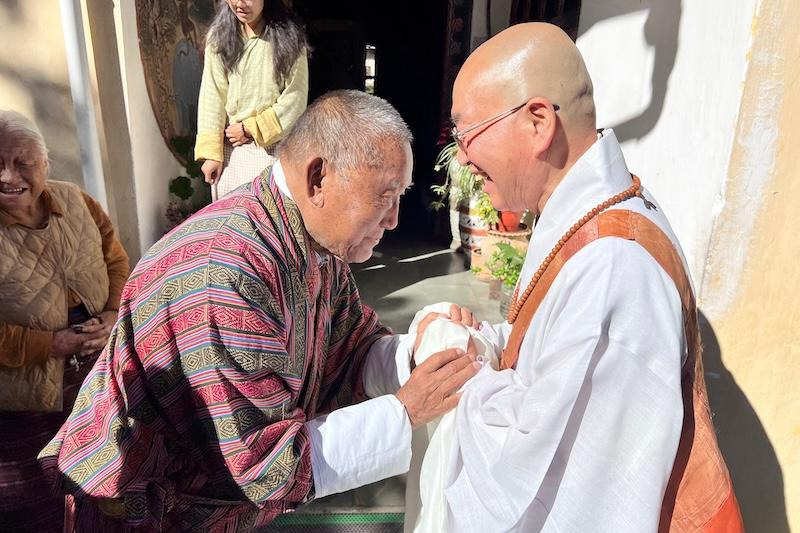
“Welcome, Venerable.”
“It’s wonderful to see that you look healthy.”
After exchanging warm greetings, Venerable Pomnyun gave a detailed explanation of JTS’s sustainable development projects currently underway in Zhemgang and Trongsa, and listened carefully to Mr. Pasang Dorji’s views. In particular, they had extensive discussions about the procurement of materials needed for Bhutan’s housing improvement projects. The Venerable began by introducing the seven development initiatives that JTS is carrying out in partnership with local communities.
“Initially, we developed a variety of plans to create a model for sustainable development projects in Bhutan. However, once we began implementing them, we found that seven areas required immediate attention. First, building homes for people who do not have a house. Second, repairing houses that exist but are in poor condition. In most cases, the toilets and kitchens need improvement. Third, paving sections of village footpaths with concrete where the paths become slippery during rain or where the slopes are particularly steep. Fourth, paving certain sections of roads used by vehicles. Since most rural roads are unpaved, it is not feasible to pave them all. Instead, we plan to pave only the sections that are especially steep or prone to water accumulation so that people can travel more safely and conveniently.”
“Fifth, there is the issue of water supply. Perhaps because this is a mountainous region, water is generally scarce. In the past, people only needed enough water for drinking. Nowadays, however, people do laundry more frequently and use more water for showers and toilets, which has led to shortages of potable water. In some places, there is barely enough water even for drinking and washing one’s face. Sixth is the construction of irrigation canals for rice farming. At present, water simply flows along earthen channels, and much of it is lost before reaching the fields. No matter where we go, water scarcity is the most serious problem. In fact, water is such a critical issue that if the water shortage could be resolved, many other problems would naturally become easier to address.”
Seventh is to install fences to protect crops from damage caused by wild animals. The fencing method needs to be improved. We plan to implement this project in phases over three years. The chain-link fences currently being installed under government projects are too expensive. Instead, we would like to provide wire mesh fencing. We also intend to change the way the fencing is constructed. At present, wild boars dig underneath the fences, and because people typically string only four or five wires loosely across the area, the fences are largely ineffective. A better approach is to place the wires closely together near the ground and gradually space them farther apart toward the top, creating multiple layers of protection.
Deer, on the other hand, tend to jump over fences, so an additional wire should be installed at a height of about two meters. Many people prefer steel fence posts because wooden posts usually rot after about three years. However, if saplings are planted during the rainy season, they can grow into living fence posts within three years, effectively becoming part of the fence itself. In that case, even if a few posts fail, it does not create a major problem. Since steel must generally be imported from abroad, we prefer to use locally available materials whenever possible.”
“Steel is now being produced in Bhutan. As a result, steel fence posts are also being manufactured locally. If you wish, we can help you purchase them at a reasonable price. However, the steel used for fencing is still imported.”
“The material we use most is cement. After that come reinforcing steel bars, wire, and water supply pipes. For the water supply projects, we are planning pipelines of approximately 5 to 7 kilometers, so a substantial quantity of pipes is required. We also need roofing materials, kitchen sinks, and toilet fixtures. The quantities needed for any single item are not particularly large, but when you are building hundreds of houses, the overall scale becomes quite significant.”
“If cement can be sourced from areas relatively close to Zhemgang, transportation costs can be reduced. Reinforcing steel bars and steel fence posts, on the other hand, can be produced locally, while only the steel wire used for fencing still needs to be imported. For materials that are not available locally, costs can be lowered by establishing direct connections with factories in India. I would be happy to assist with that.”
“Purchasing materials locally makes transportation and logistics easier, but the unit prices tend to be higher. Buying directly from manufacturers reduces the cost of the materials themselves, but then transportation and distribution expenses must be added. We are currently evaluating which approach would be the most cost-effective. At the moment, reports are being submitted from each region detailing the houses to be built through this year and next year’s farming season, along with the materials required. Once the upcoming meeting is held, the total quantity of materials needed should be determined within a few days.”
“Once everything is ready, please send me the details. I’ll prepare a quotation for you.”
“You don’t need to handle the day-to-day work yourself. Just tell the staff in charge to ‘take good care of them and give them the best possible price.’”
“Yes, of course.”
After nearly an hour of discussion, they concluded the meeting by taking a commemorative photograph together.
Meeting with Karma Tsiteem
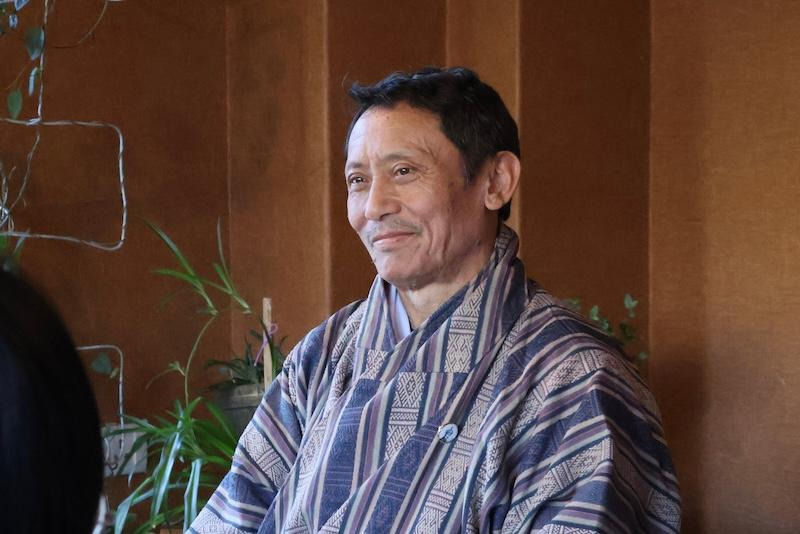
At 3:30 p.m., the Venerable met with Karma Tsiteem, who previously served as Chair of Bhutan’s Royal Civil Service Commission and the former Secretary of the Gross National Happiness Commission.
He is someone from whom the Venerable has regularly sought advice since beginning sustainable development work in Bhutan. The Venerable first shared the detailed results of this visit to Bhutan. In response, Mr. Karma Tsiteem smiled and replied.
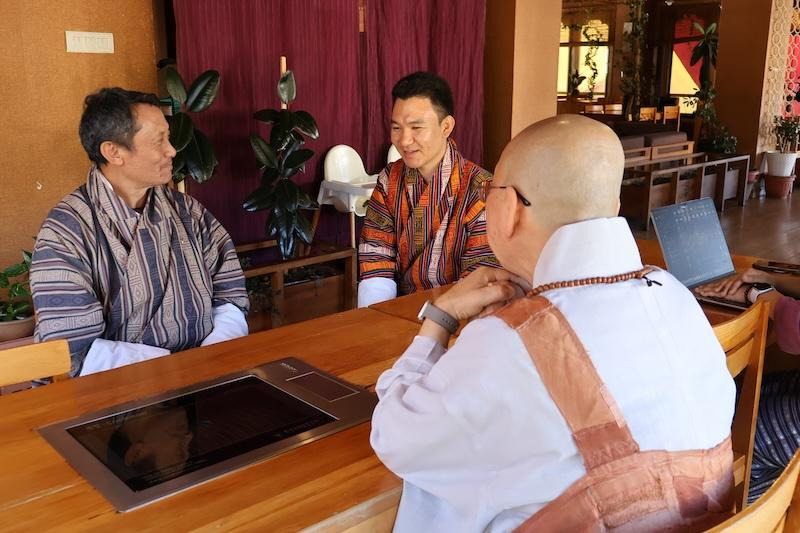
“Before JTS began its projects in Bhutan, there had already been many similar initiatives. However, due to various challenges, they were not successful. This time, because you are personally overseeing the work and carefully reviewing each aspect step by step, I believe it will surely succeed.”
“Above all, the initial setup is the most important. That is why I visited Bhutan ten times last year alone. We need to establish the right principles from the beginning so that they can be followed consistently in the future. Let me give an example from Trongsa. On the upper side of the mountain there is Korphu village, and below it is Nabji village. This time, the people of Nabji village built an irrigation canal on their own. In contrast, the people of Korphu village initially gave up, saying, ‘The transportation costs are too high,’ and ‘There is too much work involved.’ However, after Nabji village completed the canal, the water was able to flow much farther, conflicts over water disappeared, and farming improved. Seeing this, the people of Korphu village finally came forward and said, ‘We want to do it too.’ Instead, the people of Korphu village did a good job improving their road. The road had originally been so steep that vehicles could hardly pass through. After repairing seven sections, it is now accessible for vehicles.”
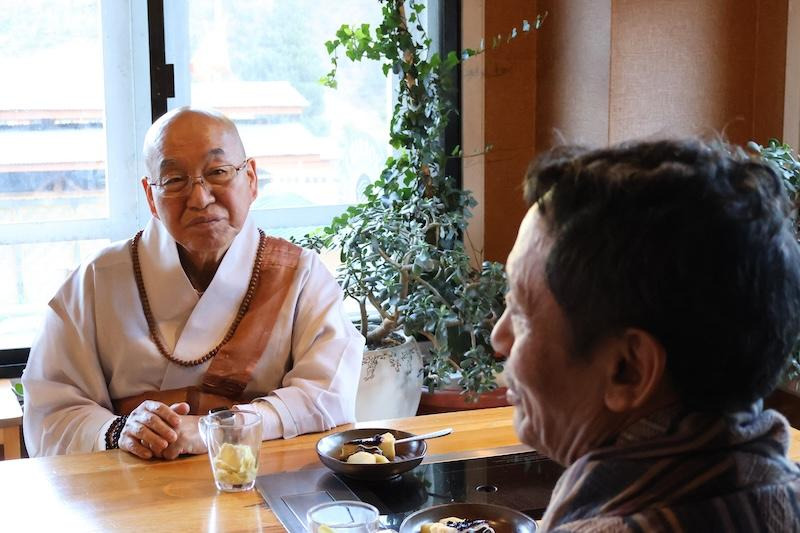
“However, these outcomes vary greatly depending on the kind of Chokba (village leader) in charge. In some areas, the Chokba is highly proactive, and those communities achieve three or four times more results than others.
In particular, JTS does not simply distribute materials equally to every village. Instead, based on certain principles, JTS provides more support to communities where residents actively participate and less support to those where participation is limited. As a result, villages with higher levels of community involvement achieve greater progress.”
“I think that is a good approach.” As a token of appreciation for Mr. Karma Tsiteem, who has always offered generous advice and guidance, Venerable Pomnyun presented him with Gongjindan, a traditional Korean herbal medicine brought from Korea.
“You are already providing so much support for people in need. I am truly grateful that you even thought to bring a gift for me personally.” When Mr. Karma Tsiteem expressed his appreciation, Venerable Pomnyun smiled and replied:
“The concept of Gross National Happiness was first introduced by the King of Bhutan. And the person who has carried on that philosophy and put it into practice for many years is you. In future societies, it is essential to consider not only human well-being but also the natural environment. Without doing so, modern civilization will not be sustainable for long. I came to understand this concept thanks to you, Mr. Karma Tsiteem. That is why I have always been deeply grateful.”
“Please feel free to let me know anytime if there is anything you need in the future. There may not be much I can do to help, but if you ask, I will gladly do whatever I can.”
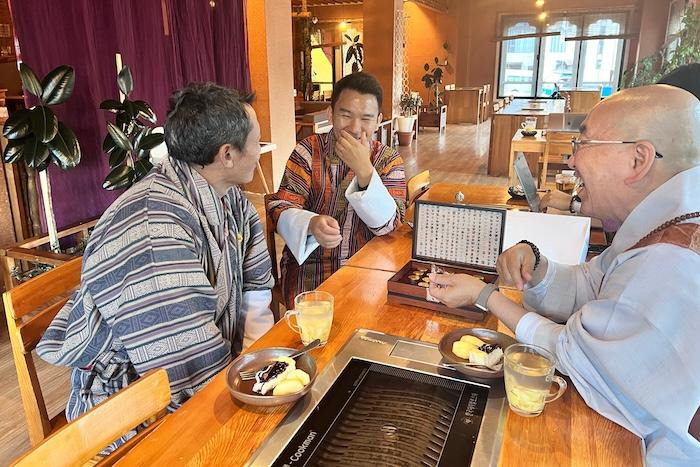
“Because Bhutan is a country that embraces the concept of Gross National Happiness, it is a place where we can work together with the government as well. There are very few countries in the world that have this kind of vision and awareness.
That is why we have received many proposals from other places, such as Cambodia and Myanmar, saying, ‘We would like to try something like this as well.’ If we achieve a certain level of success in Bhutan, many other regions will want to adopt it as a model and implement similar approaches. That is why the work we are doing in Bhutan right now is extremely important.”
“Since you are personally leading this effort, there is no reason to doubt that it will succeed.”
“We do not know yet. That is why we are not accepting donations at this stage. We will accept support after we succeed. Once it becomes successful, we will tell people that we need their help.”
Meeting with the Queen Mother and Dr. Tashi Jangmo
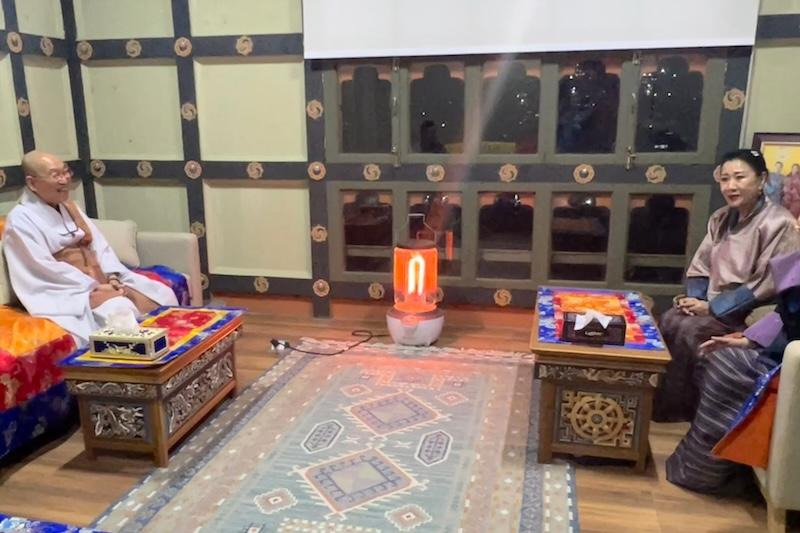
As the sun was setting, at 6:30 p.m., the Queen Mother of Bhutan, the mother of the current King of Bhutan and Royal Patron of the Bhutan Nuns Foundation, along with Dr. Tashi Jangmo, Executive Director of the Bhutan Nuns Foundation, came to visit Venerable Pomnyun. The Queen Mother had prepared sandwiches, momos (Bhutanese-style dumplings), and other food for the Venerable. They shared the meal together in place of dinner and spent time in a meaningful conversation. The Venerable began the conversation by sharing updates about young people in Korea.
“Before, young people in Korea could buy a home and have hope that they could achieve anything if they worked hard. However, although young people in Korea today enjoy a higher standard of living than in the past, many no longer have the hope that they can buy a home through their own efforts, no matter how hard they work. As a result, many choose not to get married and have children. Korea’s current fertility rate is 0.72 births per woman, which is among the lowest in the world. For a population to be maintained, two people who marry would need to have two children, but today there are many cases where couples do not have even one child. On the other hand, Korea has the highest suicide rate among Organization for Economic Cooperation and Development (OECD) countries. Around 26 people per 100,000 population die by suicide, and on average about 35 people take their own lives each day.”
“Young people in other countries often see Korea simply as a good and successful country. In reality, Korean society is well-organized, and daily life is highly convenient. These days, Korea is also widely recognized around the world through K-dramas and K-pop. However, the young people who actually live within that society are struggling emotionally. There are hundreds of thousands of young people who have withdrawn from society and live isolated lives, rarely leaving their rooms. That is why the Jungto Society organized an event called the ‘Youth Festa’ to create a space where young people can be understood, supported, and encouraged. Many prominent figures from various fields—including entertainers, politicians, and education officials—have also willingly agreed to give lectures free of charge.”
“As this example shows, a higher level of material prosperity does not necessarily mean greater happiness. In the past, people could get married even if they were poor, but these days, many young people reportedly reach their thirties without even having experienced a romantic relationship. That is why, in Bhutan, I encourage village residents by saying, ‘Let us make the villages where we live into places where we can live well. If everyone leaves for the cities, who will remain in our hometowns? The places where you live have clean air, pure water, and beautiful natural surroundings. Even if you cannot live a wealthy life, you already have a home, so you can keep it clean and make it a pleasant place to live. When your grandchildren who have moved to the cities come back to visit their grandparents, the house should not feel uncomfortable. It should have a kitchen, a toilet, and a reliable water supply. Also, because the roads are steep, we should pave them with concrete so that people do not slip on rainy days.’ In this way, we are encouraging residents to gradually improve their own communities and transform their villages into better places to live through their own efforts.”
“Thank you so much. I hope Bhutan will not become like Korea.”
The Venerable then respectfully invited the Queen Mother to visit Korea next year.
“If you visit Buddhist nun temples located in the mountains of Korea, I believe you will gain valuable ideas on how Bhutan can develop its tourist destinations and cultural heritage sites.”
The Queen Mother gladly accepted the invitation.
What Matters More Than the Project Is the Self-Reliance of the Residents
On November 5, 2025, after completing his five-day schedule in Bhutan, Venerable Pomnyun, Chairman of JTS, briefly met with JTS Bhutan staff members to discuss ongoing work before departing for the airport to return to Korea. He first shared several points to keep in mind when working together with local residents.
“Do not push the projects too forcefully. From the residents’ perspective, simply making a living is already a major challenge. In that situation, taking on additional labor, such as building someone else’s house or paving roads, is by no means easy. Of course, we also need to be mindful of costs and efficiency, but what I consider most important is fostering the residents’ sense of self-reliance. If we achieve some results and residents begin participating with genuine enthusiasm and a sense of joy, then at that stage, it is better to apply the principles with some flexibility and provide support generously. However, in the early stages, it is necessary to strictly adhere to the principles.”
“For example, in Nabji village, residents’ skills improved significantly through their participation in collective community labor. This process became an opportunity for them to learn and grow. The kindergarten building in the village of Dungeshwari in India may look modest from the outside, but it was built by students from the Labor School as part of their practical training. Through that hands-on experience, they were able to develop into skilled workers. There is a significant difference, in terms of experience, between simply practicing alone and actually constructing a building yourself. Even if there are some shortcomings, rather than only pointing them out, it is important to give people time and allow them to learn and figure things out on their own.”
The activists also shared the challenges they had encountered in the field. “While carrying out temple renovation projects, we sometimes face difficulties because residents are very enthusiastic, but they expand the scope of the work on their own without consulting with JTS.” Venerable Pomnyun smiled and replied.
“It takes rural residents a long time to understand the concept of principles and rules. Going forward, when planning projects, we need to anticipate that residents may make decisions on their own and take that into account. There is no need to dwell on what has already happened; we should always focus on how to move forward. Because residents have lived their lives without a fixed framework, the very idea of ‘principles that must be followed’ is unfamiliar to them. This does not mean that they are intentionally breaking the rules. Even the concept of dates and deadlines may not be very clear, so even if we agree, ‘Let’s finish this by a certain day,’ it is often difficult for them to keep that commitment. We need to carry out projects while taking this cultural context into consideration. At the next stage, we should gradually improve by asking questions such as, ‘Last time we were not able to keep our promise. How should we approach it this time?’”