[India] Sujata Academy Marks Its 32nd Anniversary
2026-04-14
On January 28, 2026, Sujata Academy held a ceremony to commemorate the 32nd anniversary of its founding. The 35th India Pilgrimage Group of Jungto Society also attended the celebration.
Prior to the ceremony, at 8:30 a.m., a memorial service was held in honor of the late Seong-bong Seol. In the early days of JTS India, he lost his life while resisting an intrusion by armed assailants. Venerable Pomnyun, JTS India activists, and the pilgrimage group gathered in front of his memorial stupa and paid their respects in remembrance.
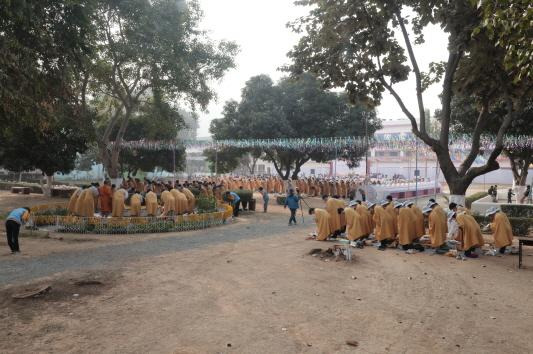
△ Memorial Service for the Late Seong-bong Seol
Starting at 9:20 a.m., villagers began arriving at the school. Following guidance from JTS staff, they entered in an orderly manner. Dressed neatly and beautifully, the villagers attended the event with cheerful expressions, accompanied by their children as if enjoying a picnic together.
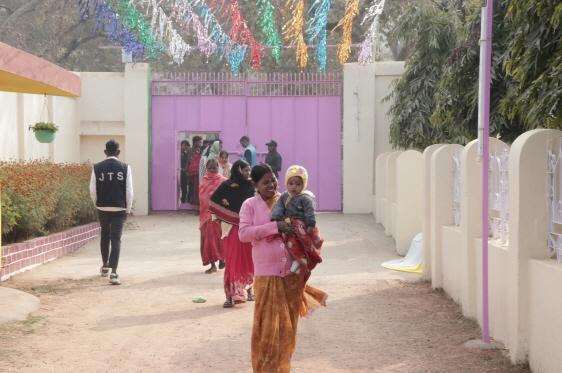
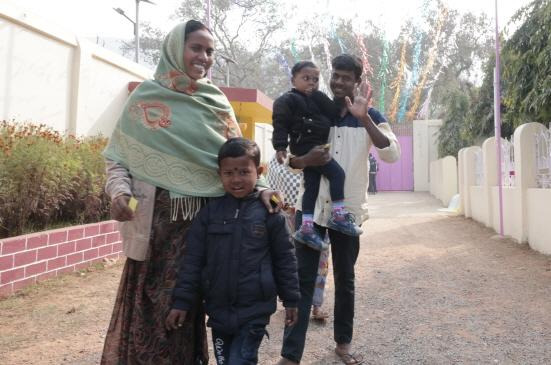
Dungeshwari Village Residents Attending the Anniversary Celebration with Bright Smiles
The anniversary ceremony had traditionally been held each year in the Pragbodhi Hall auditorium, but this year it took place on the school grounds. Carpets were laid across the entire field to ensure that both village residents and students could participate comfortably.
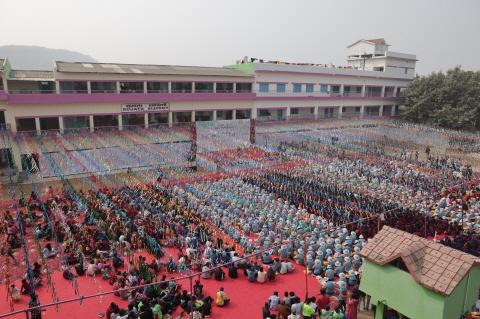
△ Overview of the Anniversary Celebration
The school grounds were filled with residents of Dungeshwari Village and invited guests soon. Among those in attendance were Dr. Prem Kumar, Speaker of the Bihar Legislative Assembly; Sarvjeet Paswan, Member of the Bihar Legislative Assembly; police officers and military personnel from Gaya who had accompanied and provided security for Venerable Pomnyun in the preceding days; the head monks of the Myanmar Temple and Cambodian Temple in Bodh Gaya; and many people who had been connected with Sujata Academy since its early years. Before the ceremony began, Venerable Pomnyun greeted and exchanged greetings with the invited guests.
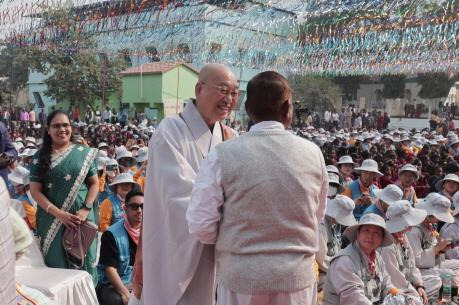
△ Sunim Greeting Invited Guests
At 10:00 a.m., the ceremony celebrating the 32nd anniversary of Sujata Academy officially began. Dressed neatly in their uniforms, the students opened the event by singing Panchsheel (the Three Refuges and Five Precepts) together, followed by the school song.
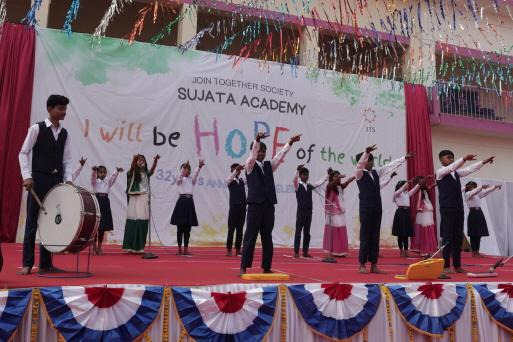
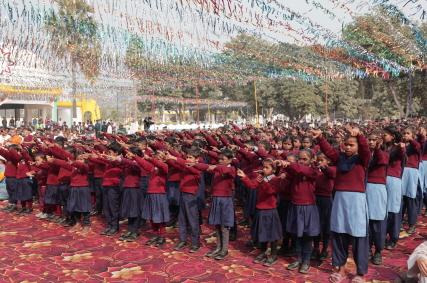
△ Students Singing Panchsheel (the Three Refuges and Five Precepts) and the School Song
This was followed by congratulatory remarks from invited guests. Venerable Priyapal, Chair of JTS India; Dr. Prem Kumar, Speaker of the Bihar Legislative Assembly; and Sarvjeet Paswan, Member of the Bihar Legislative Assembly offered their congratulations on the 32nd anniversary of Sujata Academy.
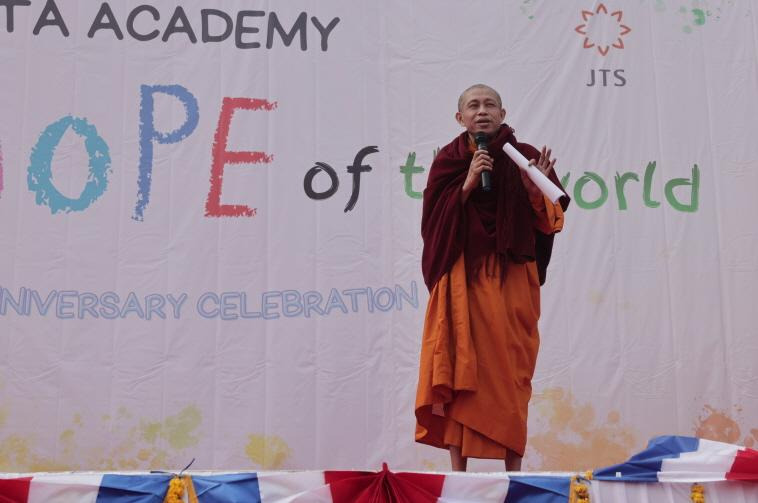
△ Congratulatory Remarks by Venerable Priyapal, Chair of JTS India
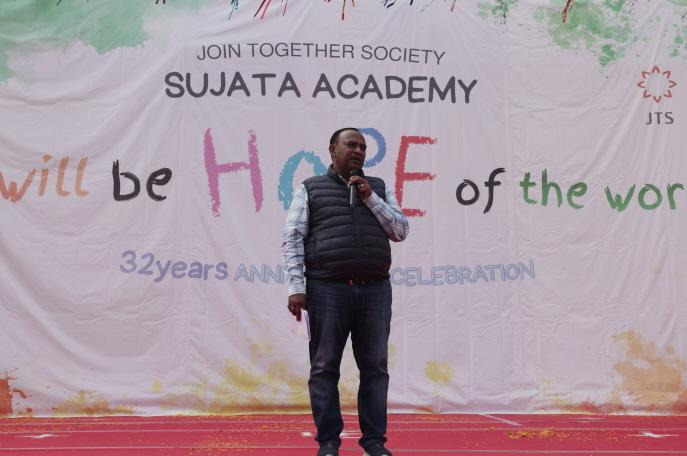
△ Dr. Prem Kumar, Speaker of the Bihar Legislative Assembly, Delivering a Congratulatory Address
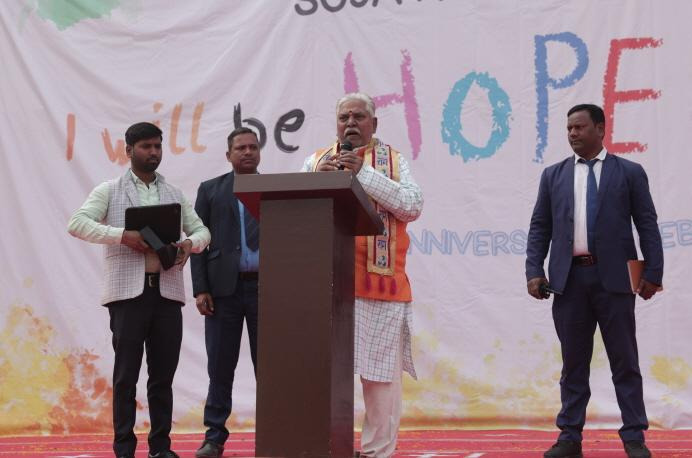
△ Sarvjeet Paswan, Member of the Bihar Legislative Assembly, Delivering a Congratulatory Address
The celebration continued with student performances, including dance and a Taekwondo demonstration, as well as traditional dance performances and musical performances by village residents featuring songs and instrumental accompaniment.
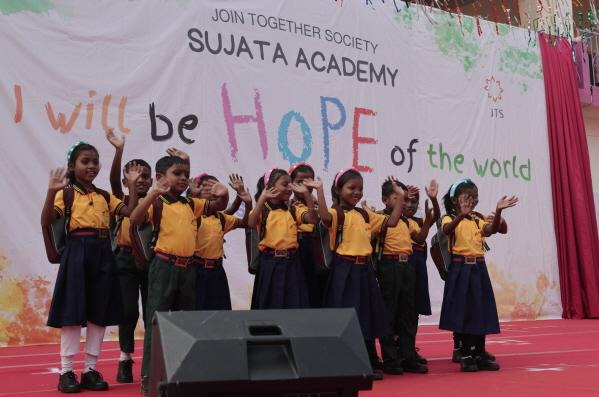
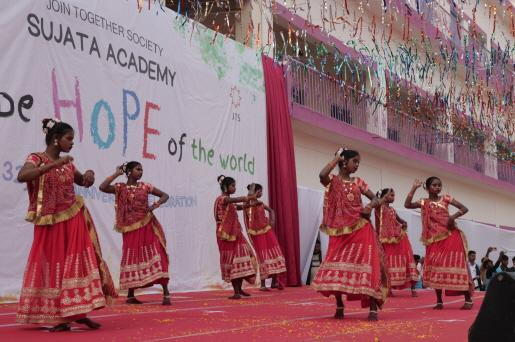
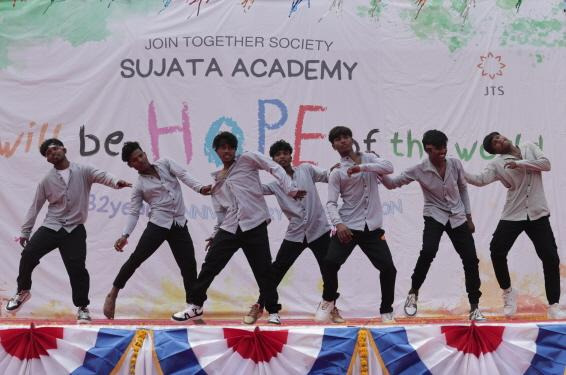
△ Students Performing a Congratulatory Program
Among the performances, the girls’ Taekwondo demonstration received the most enthusiastic response. Each time they executed strong and confident movements, the audience erupted in loud applause and cheers.
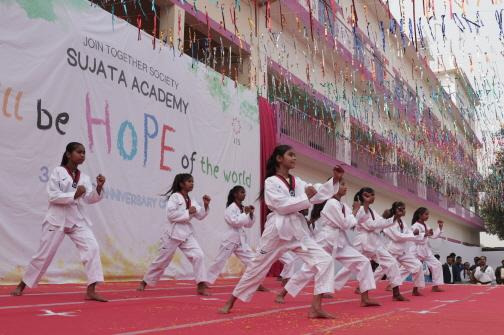
△ Female Students Demonstrating Taekwondo
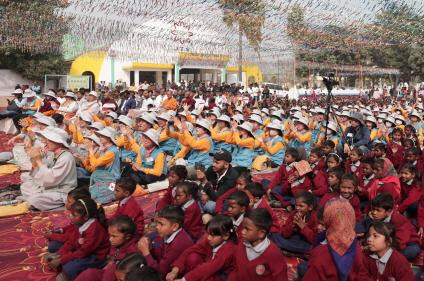
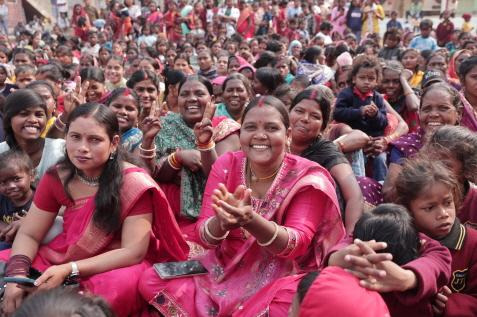
△ 학생들 공연에 박수와 환호를 보내는 참석자들
△ Attendees Applauding and Cheering Student Performances
Most of the children in Dungeshwari Village attend Sujata Academy, meaning that the majority of village residents are parents of students. Not only the students but also the villagers took part by presenting their own performances.
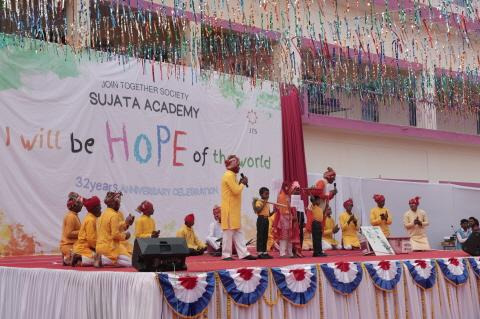
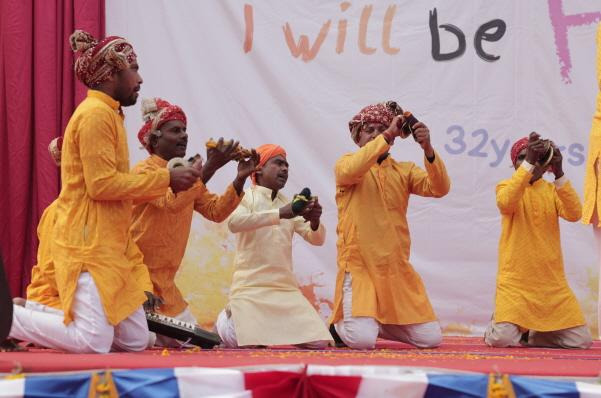
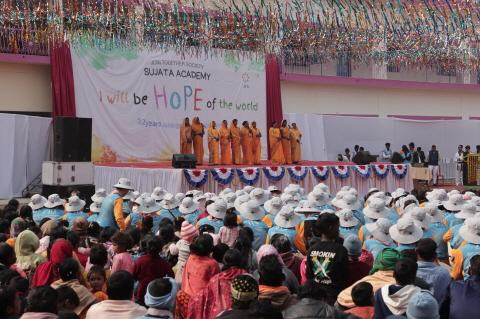
△ Parents’ Congratulatory Performances
After all the prepared performances had concluded, Venerable Pomnyun took the stage to express his gratitude to everyone in attendance.
“I would like to extend my heartfelt thanks to all the distinguished guests present today, the more than 500 Korean pilgrims, and the village leaders for joining us here.”
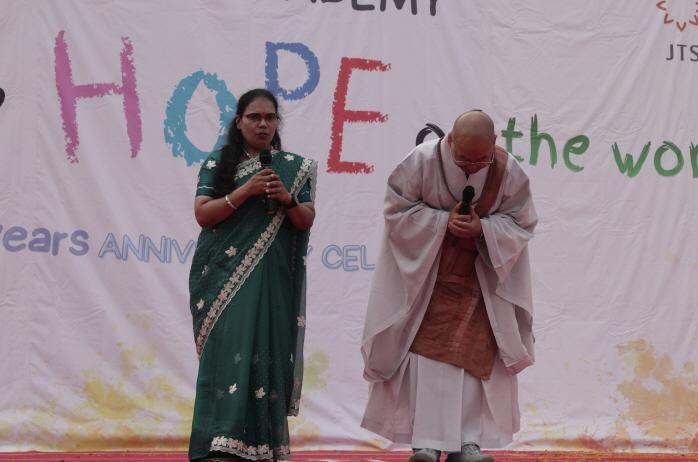
△ Venerable Pomnyun Bowing to the Anniversary Ceremony Attendees
Dungeshwari is the land where the Buddha practiced asceticism for six years 2,600 years ago. In the past, it was regarded as an impure place where corpses were discarded, but through the Buddha’s practice here, it was transformed into a sacred site of cultivation and has now become a pilgrimage destination visited by people from all over the world. The Buddha transformed even impure places into sacred ones. Likewise, we too should follow the Buddha’s teachings and work to turn difficult places into livable and thriving communities.
Before Sujata Academy was established, this area had many people living in poverty with limited access to education. However, since the school was founded, significant changes have taken place, to the extent that there are now no children in the area who are not attending school. JTS has operated kindergartens, primary schools, and middle schools based on the principle that children should receive timely education regardless of religion or gender. As a result, illiteracy in this region has been effectively eliminated, and it can be said that there are no children left without access to education.
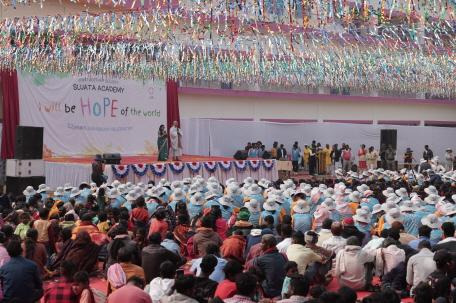
△ Venerable Pomnyun Speaking on the Educational Transformation of Dungeshwari Through Sujata Academy
Our next task is to ensure that no sick person is left without treatment. Even if people are poor, there should be no one suffering because they have no place to live. We must work toward creating villages where every child receives education, every sick person receives medical care, and everyone is able to have at least a home of their own—so that basic human living conditions are guaranteed for all.
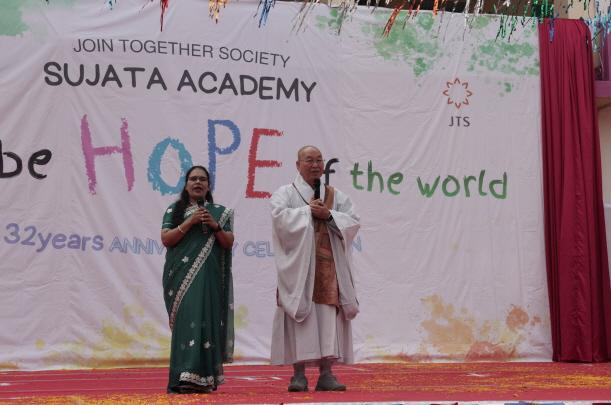
△ Venerable Pomnyun Emphasizing the Need to Unite for a Better Dungeshwari
This work cannot be accomplished by JTS alone. It is only possible when Bihar State, Gaya City, village residents, local leaders, and young people all come together. We must transform Dungeshwari—where the Buddha practiced asceticism for six years—into a village where education, healthcare, and housing are fully ensured. Just as we have walked this path together until now, let us continue to join our efforts and move forward together
“Seeing our children dancing and singing on stage today, aren’t you proud to show them anywhere?”
“Yes!”
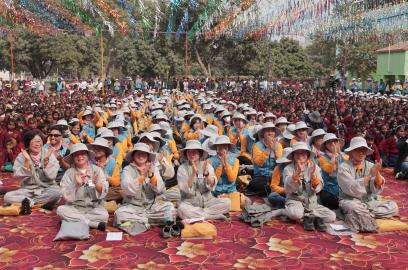
△ Attendees Applauding Sujata Academy Students with Pride
“If any child receives a good education, they can grow up to become a capable and admirable person. If we unite our hearts, we can transform Dungeshwari into a livable and thriving village. With this hope, let us move forward together. Once again, I extend my deep gratitude to everyone who joined us today, including Speaker Prem Kumar and all the distinguished guests.”
The final performance of the ceremony was the “Memorial Dance.” It was a stage performance that expressed, through dance, the journey from a vow made by a practitioner in 1993, to the establishment of the school, and onward to the present and future of Sujata Academy.
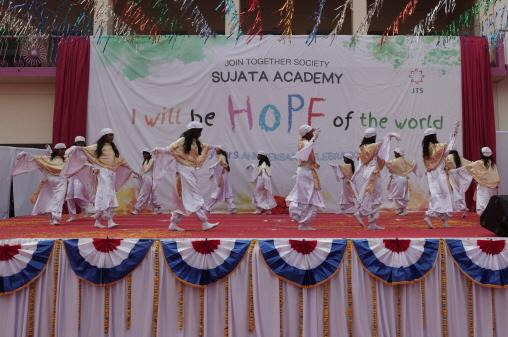
△ Sujata Academy Students Performing as the Hope of the World
The children danced confidently beneath the banner reading, “I will be HOPE of the world.” The audience joined in the final performance, swaying their hands like waves in unison.
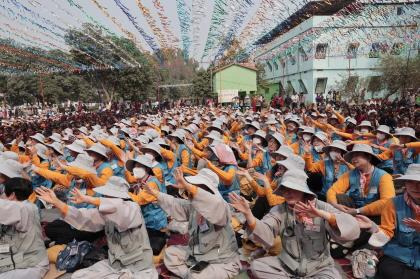
△ Attendees Enjoying the Students’ Performances
After Venerable Pomnyun and all the distinguished guests went up on stage to take a commemorative photo with the children, the 32nd anniversary ceremony came to a close.
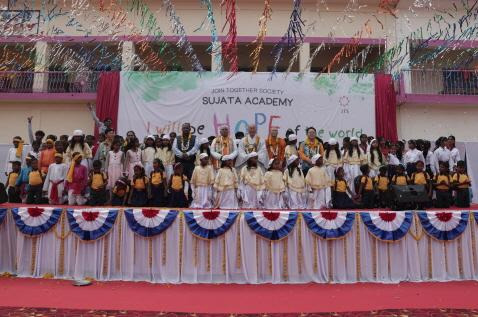
△ Commemorative Group Photo of the 32nd Anniversary Ceremony
Venerable Pomnyun shared a lunch with the guests. A meal was carefully prepared by Sujata Academy. The villagers received lunch boxes prepared by the school and returned to their homes.
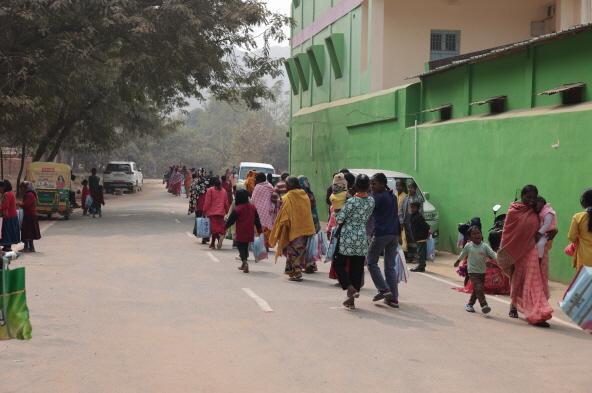
△ Villagers Returning Home with Lunch Boxes
Sharing the Story of 32 Years of Sujata Academy and Its Transformation
In the evening, a lecture was held with the participation of the Jungto Society India pilgrimage group. Prior to the lecture, Sujata Academy’s “BTS” performed a special stage for the pilgrims.
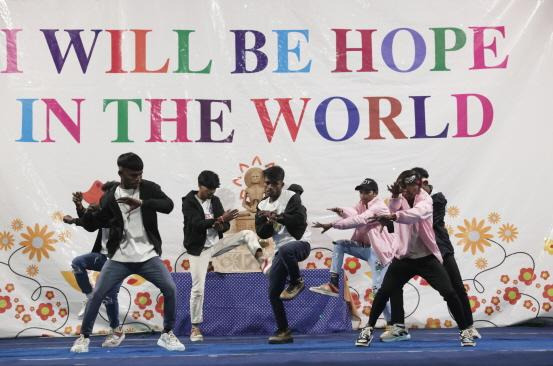
△ BTS Performance by Sujata Academy
After the children’s impressive dance performance concluded, Venerable Pomnyun’s lecture followed. Referring to the children’s performance, he began by saying that the Buddha’s teaching—that all conditioned things are subject to change—is being demonstrated as a reality in this school.
“The children are really talented, aren’t they?”
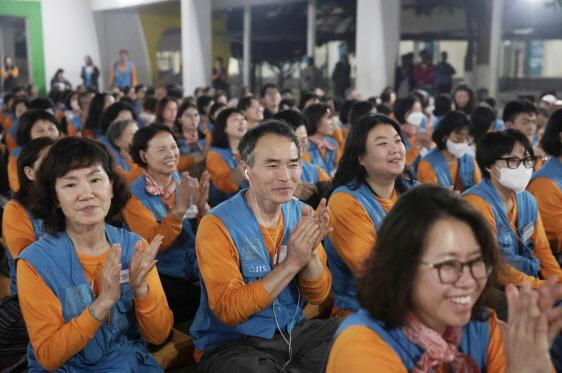
△ Pilgrims Applauding the Performance
“Yes!”
“When the same person is begging, they may appear undignified. But with just a little education, their talents become visible like this. This is the Buddha’s teaching being demonstrated in reality. In the past, children were often born into so-called ‘low’ castes, poverty, and without any opportunity to learn, and as a result they were seen as lacking talent or capability. People easily accepted a fatalistic view, saying, ‘They were born into a low status because of sins in a past life,’ or ‘They were born poor because they did not accumulate merit in a previous life.’
However, the Buddha taught that “karma is not fixed; it is conditioned.” In other words, “all conditioned things are impermanent,” which in Chinese is expressed as “all formations are impermanent” (諸行無常, jehaeng museong). Our suffering is not something that has existed from the very beginning; it is something that has been formed. Likewise, our habits of life are not innate—they are constructed. If we understand their causes and eliminate those causes, then what has been formed can change, and our lives can also change. There is no life that is predetermined to be filled with suffering. Everyone has the ability to move toward a life of happiness on their own.
Sujata Academy at 32 Years: What Have We Been Proving?
We have been directly demonstrating this truth here at Sujata Academy for the past 30 years. Children who once begged have grown into respectable young adults and are now fulfilling their roles across various parts of society. However, there are still realities in which, due to institutional and systemic limitations in society, these children are unable to fully realize their talents. In order to take on social roles, individual effort alone is not enough—the social system itself must also change. For example, even if women are highly capable, their talents cannot be expressed if systems are designed in such a way that prevents them from participating in society. Even when doors are formally open, the outcome is the same if people are not given the education needed to enter those doors. Therefore, at the individual level, access to education is essential, and at the societal level, opportunities must be open to everyone so that they can participate and contribute.
When Sujata Academy was first established, it was mainly children from so-called “Dalit” (marginalized) communities who attended the school. At that time, even within those communities, there were one or two children in each village who had completed middle school, and those students were selected to serve as teachers. There was no real concept of “parents” engaging with the school. Children were happy to come to school to receive candy, but very few people actually supported the idea of building a school in the first place.
Principles Established Amid Discrimination and Conflict
In contrast, in the “general caste” villages, children were already attending school. However, when a school was opened nearby and food was also provided, they came in large numbers all at once. But when teachers were selected from Dalit backgrounds, villagers protested, saying, “A Dalit cannot teach our children.” As a result, villagers gathered to lodge complaints, and I personally met with them to discuss the matter.
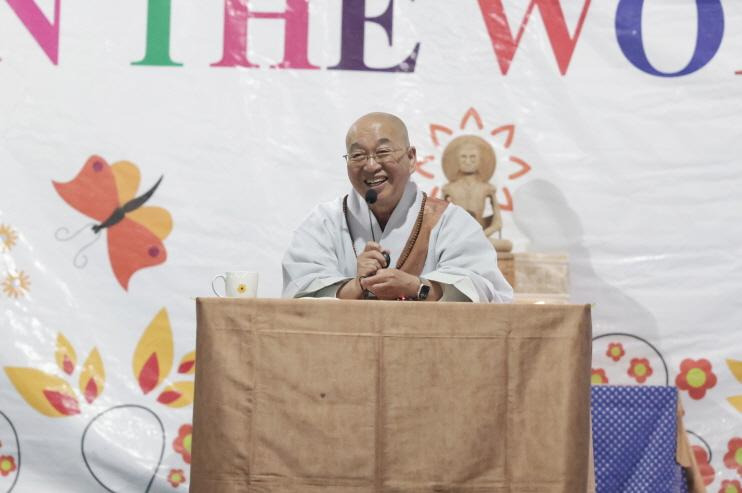
△ Venerable Pomnyun Speaking on the Changes Brought About by Sujata Academy
When I asked, “There are government schools, so why do you send your children to Sujata Academy?” they replied that it is because the school provides better education. So I asked again, “Then should we run the school in the Korean way or the Indian way?” The villagers asked us to run it in the Korean way. So I explained as follows.
“If we run it in the Korean way, there is no discrimination based on gender or caste. When hiring teachers, we look only at whether they are capable of teaching children. We do not consider whether someone is Dalit, male, or female. If we are to follow the Korean system, that is how it must be done.”
When I explained this, even those who had been protesting gradually calmed down. In the Indian system, it is common for teachers to come to school only once a week. In rural areas, there are frequent cases where teachers receive salaries but do not regularly attend school. When I lived in this village in the past, I even saw cases where a teacher would come only once a month. Because of this, attendance rates in rural public schools are often below 15 percent. In contrast, Sujata Academy’s attendance rate exceeds 95 percent.
Meanwhile, when we appointed Priyanka as a teacher, there was opposition from the Dalit village community. They objected, saying, “Why are you hiring someone from a high caste like a Brahmin in a school built for Dalit children?” However, running a kindergarten properly requires a higher level of professional training. Teachers from Dalit backgrounds at that time had typically completed only middle school or high school, whereas Priyanka had completed a master’s degree. So we responded, “If there is anyone within the Dalit community who has this level of qualification, we will hire that person instead.” In the end, we were able to clearly establish and communicate the principle that what matters is not caste or gender, but whether a person is qualified to teach—and we were able to persuade the community based on that standard.
While running the school, there were even incidents in which armed robbers intruded, and a staff member lost his life. Internal conflicts between villages were also very severe. Because of the custom of early marriage to reduce dowry burdens, there were cases where children were already in their first marriage while still attending primary school. Until Teacher Priyanka arrived, all the teachers were male, as it was extremely difficult for women to live in such a remote area. Corporal punishment of children was also common, and there were even rumors of sexual harassment arising in that context. Tensions were further heightened by the fact that the teacher came from Sankasia in Uttar Pradesh. In response, I personally collected testimonies from individuals one by one to verify the facts, and was able to clarify that the rumors had been exaggerated, thereby helping to stabilize the situation.
After going through many twists and turns like these, we have arrived at where we are today. Now, even the girls ask to be taught Taekwondo just like the boys. In the past, only boys would go on stage when it was time to dance, but today girls also wear trousers, go up on stage, and dance freely. So much has changed over the past 30 years.
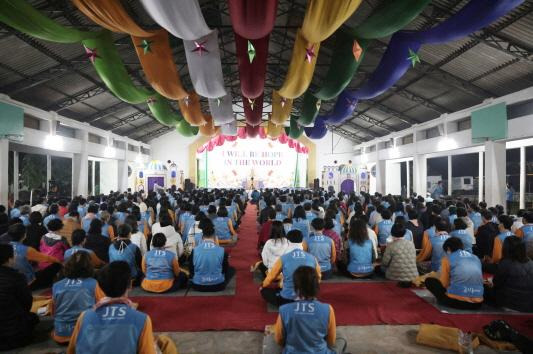
△ Pilgrims Listening Attentively to 32 Years of Sujata Academy
In fact, this society has much deeper gender discrimination than caste discrimination. While it is important to teach that discrimination is wrong, even more important is the experience of studying together without discrimination within the school itself. When children grow up in such an environment, they naturally become friends regardless of their backgrounds, and even if they later encounter discrimination in society, its impact is significantly reduced. For six to eight years, the children receive education in an environment of equality, gradually transforming the way they perceive society itself.
What we can do is provide opportunities to individuals. Of course, even if a person has great talent, it is difficult if society does not provide opportunities. First, the seed must be good—individuals must bring about their own transformation. At the same time, the soil must also be good; only then can the seed grow properly. Just as good soil cannot produce a harvest without seeds, and good seeds cannot grow without soil, change occurs only when causes and conditions come together. What we can do is create the causes. For these to become conditions, the children must grow up, assert their own rights, and lead social change themselves.
What is happening in this village may not seem extraordinary to us. However, the people here have long lived with the belief that poverty and low status are the result of karma from past lives. In the past, we too lived within feudal ways of thinking. In this sense, education here is about demonstrating, through lived experience, that human destiny is not fixed.
What we do is not simply teaching children. The time for merely saying, “This is what the Buddha’s teachings are,” has already passed. That was something said 2,600 years ago. What is important for us today is how the Buddha’s teachings can be embodied and realized in the realities of the present day.”
A Q&A session with the pilgrimage group followed, and the lecture concluded after 9 p.m. Venerable Pomnyun emphasized that what matters most is how the Buddha’s teachings can be implemented and realized in today’s world.
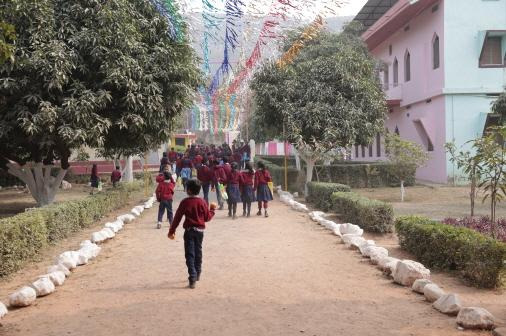
△ Scene of Children at Sujata Academy
JTS is not an organization belonging to any particular religion. However, based on these teachings, it continues its activities to help people transform their own lives and build a better society.